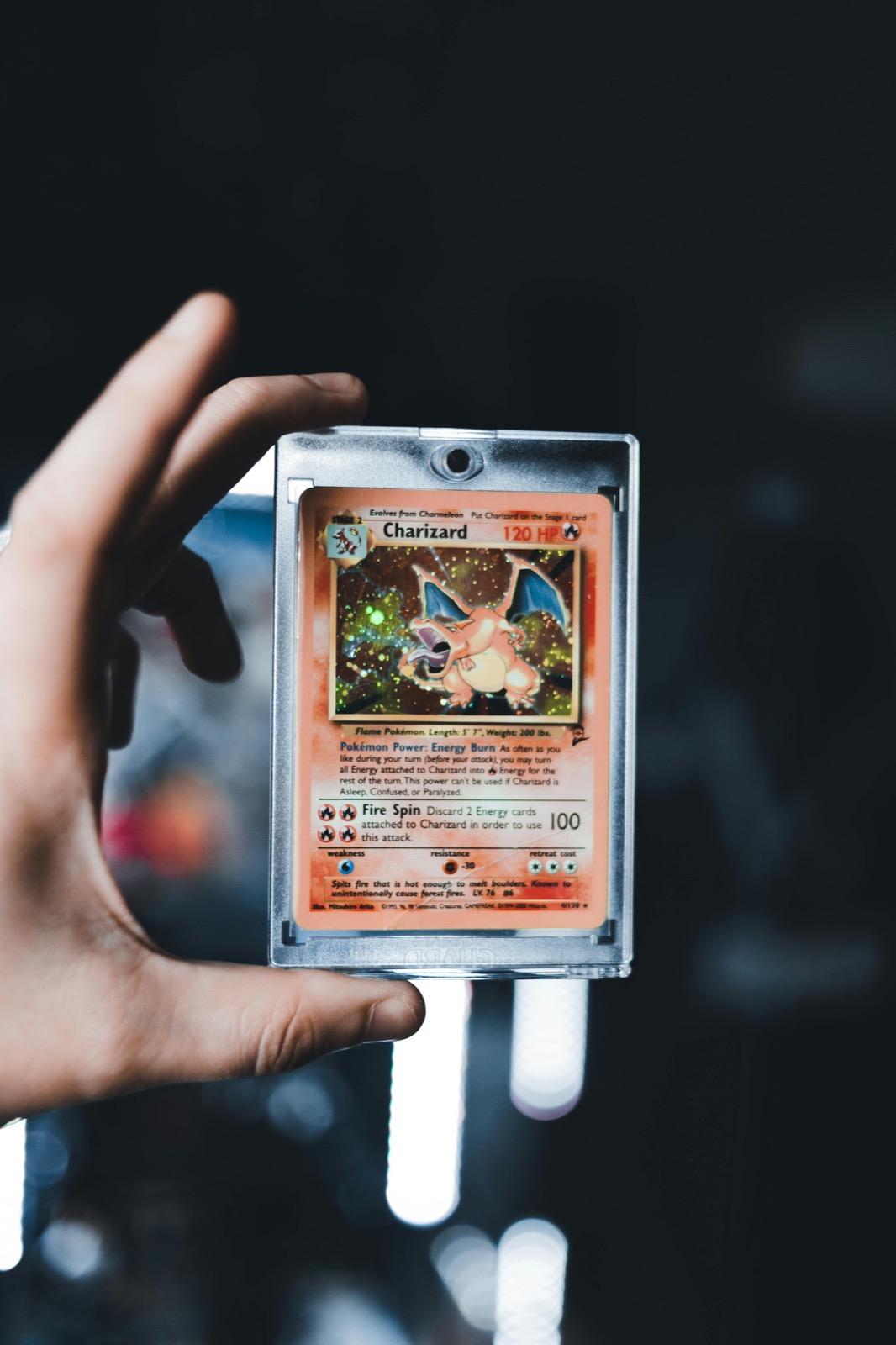
Two eras, two collecting games
Pokemon TCG collectors tend to talk about "the hobby" as if it were one thing, but anyone who has held a 1999 Base Set Charizard next to a 2024 special illustration rare knows that is not really true. Vintage and modern Pokemon cards are two different collecting games that happen to share a brand, a font family, and a board game.
A serious collection usually leans toward one era or quietly straddles both — and the people who do best across both eras are the ones who understand the differences instead of treating every card the same way.
What counts as vintage versus modern
There is no official cutoff, but most of the secondary market draws the lines in a similar place.
A common framing:
- Vintage: Base Set through the WOTC era and into the early Nintendo Sword & Shield era — roughly 1999 through the early 2000s
- Modern: cards from the Black & White era forward, with everything from Sword & Shield and Scarlet & Violet treated as squarely modern
- A gray middle: the EX, Diamond & Pearl, and Black & White eras that are not quite vintage and not quite modern
Collectors often debate where exactly the line sits, but the framing is less about a date and more about how the card behaves in the market.
Rarity works very differently across eras
The single biggest mistake collectors make is assuming vintage rarity and modern rarity are the same idea. They are not.
Vintage rarity is shaped by:
- Print runs that are now fully closed
- Population reports that change slowly as old copies surface
- Condition scarcity that compounds with every year of handling
- A relatively short list of widely chased printings
Modern rarity is shaped by:
- Active print runs and reprints that can still expand supply
- Rapidly growing graded populations on chase cards
- Many parallel rare slots per set — full art, special illustration, gold, hyper rare
- Online promo and event distributions that complicate scarcity
The Pokemon card rarity symbols guide, Pokemon card secret rare guide, Pokemon card full art guide, and Pokemon card first edition guide cover the rarity tiers in more depth across both eras.
Condition standards are stricter on modern
A surprising number of collectors expect a near-mint modern card to clear PSA 10 just because it came out of a pack. In practice, modern grading standards are unforgiving — centering, edge whitening, and microscopic surface marks all matter more on a card that has only been alive for a few months.
A general rule:
- Vintage condition is judged in context of age and known print quirks
- Modern condition is judged in context of perfection from a sealed pack
- Both eras heavily penalize off-centering and edge wear
- Vintage tolerates print lines more than modern does
- Modern is punished hard for any factory defect on a chase card
The Pokemon card condition guide, Pokemon card centering guide, and how to prepare Pokemon cards for grading cover the inspection routine that applies to both eras, with vintage-specific notes for the older print runs.
Pricing data is thinner the further back you go
Modern cards usually have a deep pool of recent sales data, which makes pricing relatively straightforward. Vintage cards thin out fast — for some printings you may only have a few comps per month, and for some high-grade vintage you may only have one or two comps per year.
When pricing vintage:
- Lean on slabbed comps over raw listings
- Adjust heavily for grade tier and population
- Check multiple platforms, not just one marketplace
- Use a longer trailing window because comps are sparse
- Treat asking prices as upper-bound noise, not real signal
When pricing modern:
- Recent sales windows can be very short
- Distinguish quickly between hyped speculation and stable demand
- Population reports change fast for the freshest sets
- Pricing on chase cards can move within days of a new release
- Use the Pokemon card price checker to anchor against a current reference price
The how to find Pokemon card comps and how to compare raw and graded Pokemon card prices cover the comp-pulling routine that applies to both eras, with adjustments for thinner vintage data.
Storage needs are different by era
Vintage cards have already survived twenty-plus years. That is both an advantage and a fragility. They have proven they were stored decently, but they are also closer to the edge of any further degradation.
For vintage:
- Keep them in stable, climate-controlled conditions
- Avoid direct light at all costs
- Use archival-quality sleeves and toploaders
- Consider magnetic cases or slabs for high-value copies
- Limit handling to inspection and grading prep only
For modern:
- Pack-fresh handling matters far more than long-term storage
- Most damage to modern hits happens in the first ten minutes
- Sleeve and toploader within seconds of opening the pack
- Magnetic cases are common for grade candidates
- Storage temperature still matters, but the upstream handling matters more
The Pokemon card storage box guide, Pokemon card storage temperature guide, Pokemon card light damage guide, and Pokemon card pack-fresh handling guide cover the storage and handling routines for both eras.
Grading economics flip across eras
A common surprise for collectors crossing eras is that grading math works differently on each side.
On vintage:
- The grade often defines the value, not just sharpens it
- A clean PSA 9 versus PSA 10 can be a multiple, not a small bump
- Even mid-grade vintage often justifies the grading fee
- Bulk grading is rarely the right framing for vintage
On modern:
- Most cards do not justify grading at all
- Only specific chase pulls and clean centering candidates do
- Bulk grading discounts matter much more than on vintage
- Returning a graded modern at low tier often loses money on fees alone
The Pokemon card grading cost guide, Pokemon card grading turnaround guide, how to choose which Pokemon cards to grade first, and Pokemon card bulk grading strategy guide cover the grading triage that applies to both, with era-specific notes for vintage.
How to balance a mixed-era collection
Many collectors end up with both eras even if they did not plan to. A clean way to think about a mixed collection is to give each era its own role.
A simple structure:
- Treat vintage as the long-term anchor of the collection
- Treat modern as the active-flow part you scan, sort, and trade
- Keep separate storage tracks for the two eras
- Keep separate logs for vintage value versus modern value
- Avoid mixing vintage chase cards into a binder you flip through casually
The how to organize Pokemon card collection, Pokemon collection app, and Pokemon card collection tracker guide cover the inventory side of running a mixed-era collection.
What to buy first in each era
If you are deciding where to spend next, the two eras have very different "first buy" answers.
In vintage, prioritize:
- Cards with stable population reports and clear comp data
- Condition that is honestly judged against vintage tolerances
- Printings that are widely recognized, not obscure niches
- Sealed product only when authentication risk is manageable
- Slabbed copies when the gap between raw and graded is large
In modern, prioritize:
- Cards with strong centering and clean surface from the start
- Singles over sealed in most cases, with sealed as a smaller side bucket
- Hits that align with characters and finishes that retain demand
- Pack-fresh copies you can keep in grade-candidate condition
- Cards you actively enjoy holding, not pure speculation
The Pokemon card investment guide, how to tell if a Pokemon card is valuable, and Pokemon booster box vs singles guide cover the buying side across both eras.
Selling decisions also differ
When it is time to sell, the right channel is rarely the same across eras.
For vintage:
- Auction-style listings often work better — they price discovery directly
- Slab the card first if the resale gap justifies it
- Use platforms with strong buyer protection
- Take detailed condition photos that match grading-company language
For modern:
- Fixed-price listings work well for cards with deep comp data
- Group similar cards into lots when individual fees would eat margin
- Move quickly on hyped cards before the curve cools
- Be honest about centering and surface in the listing description
The where to sell Pokemon cards, how to decide which Pokemon cards to sell, and how to photograph Pokemon cards for selling cover the listing routine that applies to both eras.
A decision checklist for mixed-era collectors
Before adding or removing a card from a mixed collection:
- Is the card clearly in the vintage, modern, or middle band?
- Does the pricing data for that era support a confident value estimate?
- Does the storage spot match the condition needs for that era?
- Is the grading math right for the era and the specific card?
- Does the card belong with your vintage anchor or your modern flow?
The simple rule
Vintage and modern Pokemon TCG cards are not the same hobby — they have different rarity, condition, pricing, storage, and grading dynamics. A collection that respects those differences runs more smoothly than one that treats every card the same way. Anchor your collection in the era you care about most, give the other era its own track, and judge every card against the standards that apply to its own era — not the one across the line.