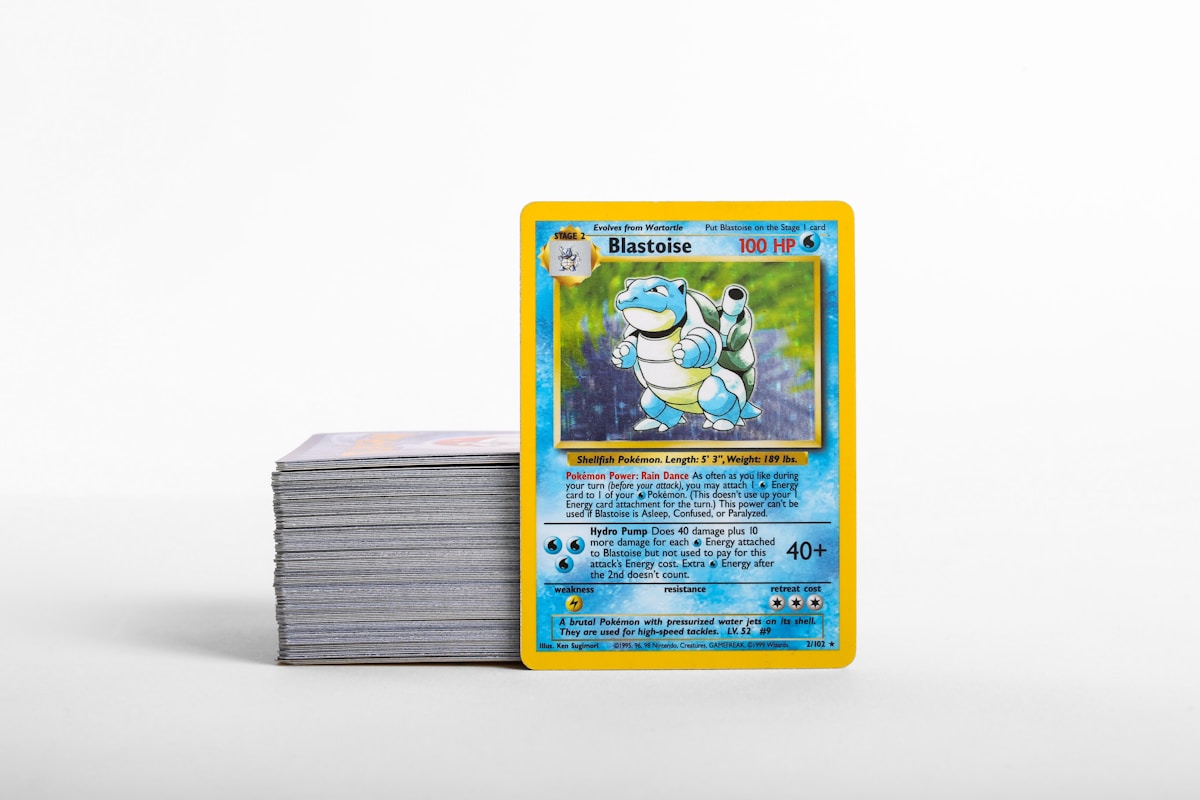
The cards that do not fit in a binder
Most of collecting is built around one standard card size, and almost every sleeve, toploader, binder page, and storage box assumes it. Jumbo cards break that assumption. They are the oversized promotional cards that come in special boxes and collector tins — too big for a normal sleeve, too eye-catching to throw away, and just different enough that most collectors never quite know what to do with them.
This guide treats jumbo cards as their own collecting category, because that is what they are. They have a different supply story, a different value curve, and different storage needs than the standard cards that fill your binders.
What counts as a jumbo card
A jumbo card — sometimes called oversized or "JUMBO" on the card itself — is a Pokemon card printed at several times the normal dimensions. They are not tournament-legal and are not meant to be played. They exist as display and promotional pieces.
The defining traits:
- Significantly larger than a standard card, often roughly the size of a sheet of paper
- Usually a reprint of an existing card's art at a larger scale
- Frequently labeled as a promo and not part of a numbered playable set
- Distributed inside special collection boxes, tins, and gift sets
- Made for display, not for play or competitive decks
Because they are reprints of existing art rather than unique playable cards, jumbos sit closer to collectible memorabilia than to chase singles. That framing explains almost everything about how their value behaves.
Where jumbo cards come from
Jumbo cards are almost always pack-in or box-in promotional items. You rarely pull them from a booster — they come bundled with a larger purchase.
Common sources:
- Special collection boxes built around a featured Pokemon
- Premium tins and gift sets
- Promotional and event distributions
- Anniversary and commemorative products
This distribution model matters for collectors because it ties a jumbo's scarcity to how many of that specific box were produced and kept. A jumbo from a limited commemorative set behaves very differently from one packed into a mass-market box. The Pokemon card promo stamp guide and how to track Pokemon card promos cover the broader promo landscape that jumbos are part of.
How jumbo card value works differently
This is where jumbo collectors get tripped up. A jumbo card's value rarely tracks the value of the standard version of the same art. A jumbo Charizard is not worth what a standard Charizard chase card is worth, and assuming otherwise leads to bad buys.
The value patterns that actually hold:
- Value is driven by the box or set the jumbo came from, not the standard card's price
- Display appeal and the featured Pokemon matter more than playability
- Condition is judged on a piece that is hard to keep flawless at that size
- Some commemorative jumbos hold value well; most mass-market jumbos do not
- Sealed-in-box jumbos can be worth more than loose ones
Because comps are thinner and the category is niche, pricing a jumbo takes extra care. Identify the exact promo and its source product, then check what the specific card actually sells for rather than assuming it mirrors the standard version. A Pokemon card price checker plus the comp-pulling routine in the how to find Pokemon card comps guide will keep you from overpaying on the strength of the artwork alone.
Storing and protecting jumbo cards
The biggest practical problem with jumbos is that none of your normal supplies fit them. A standard sleeve, toploader, or binder page is useless, and that mismatch is exactly why so many jumbos end up dinged, bent, or sun-faded.
Storage and protection priorities:
- Use oversized sleeves and rigid oversized toploaders made for jumbo dimensions
- Store them flat with rigid support, since their size makes them prone to bending
- Keep them out of direct light, which fades large flat art quickly
- Avoid leaning them upright unsupported, which encourages warping
- If the jumbo is sealed in its original box, consider keeping it that way
The same environmental rules that protect standard cards apply, just with bigger supplies. The how to protect Pokemon cards, Pokemon card light damage guide, and Pokemon card storage box guide cover the protection principles that scale up to jumbo size.
Should you grade a jumbo card
Grading jumbos is possible but uncommon, and the economics rarely favor it. Most grading slabs and population reports are built around standard cards, and the buyer pool for graded jumbos is small.
A realistic framing:
- Most jumbos are not worth the grading fee
- Only scarce, high-demand commemorative jumbos justify grading
- The buyer pool for graded jumbos is narrow, which thins resale
- Display value often beats slab value for an oversized card
- A clean, well-stored loose jumbo is usually fine without grading
If you are weighing it, run the same triage you would for any card. The how to choose which Pokemon cards to grade first and Pokemon card grading cost guide cover the cost-versus-value math that almost always sends a jumbo back to the display shelf.
Tracking jumbos in your collection
Because they do not fit your normal storage, jumbos are easy to lose track of — physically and in your records. They end up in a closet, separate from the binders, and quietly fall out of your inventory.
Keep them in the system by:
- Logging each jumbo with its source box or set, not just the Pokemon name
- Noting condition carefully given how easily large cards bend
- Recording whether it is sealed in-box or loose
- Treating the jumbo collection as its own category in your records
- Reviewing them in your regular collection audit so they are not forgotten
A Pokemon collection app lets you tag jumbos as their own category so they stay visible alongside your standard cards. The how to do a Pokemon card collection audit and pokemon card collection tracker guide cover the routine that keeps oversized cards from slipping through the cracks.
The simple rule
Jumbo cards are display pieces with their own supply story, their own value curve, and their own storage needs — not oversized versions of chase singles. Price them by their source box rather than the standard card's value, protect them with oversized rigid supplies and out of direct light, and track them as a distinct category so they do not vanish from your collection. Treat jumbos as memorabilia done right, and they become a fun, low-stress corner of the hobby instead of a pile of bent posters in a closet.